
T level in Science (Laboratory Science)
Other Courses


Course Overview
Qualification: Applied Courses
(3 A level equivalent course)
- The T Level in Applied Science uses a combination of assessment styles to give learners the confidence to apply their knowledge to succeed in the workplace and develop the study skills to continue learning throughout their career.
- There is a range of assessments – both practical and written – which allow learners to showcase their knowledge and skills to best effect when they take their next step, such as applications to higher education courses or to potential employers.
- This course comprises a mixture of assignments and exams, so it is a good option for learners who do not want to follow a 100% terminal exam-based course like A levels.
- The course covers a range of Biology, Chemistry, Physics and Science topics giving an excellent foundation for many university courses, jobs or apprenticeships.
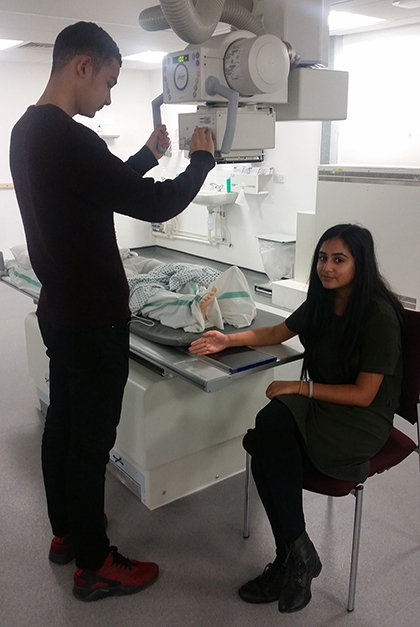
- The course is delivered in a variety of ways to help you to develop a range of skills. Classroom theory will be delivered through laboratory-based practical assignments, supported by self-study, presentations, group work and discussion.
- Throughout your course you will be taught by specialist Biology, Chemistry and Physics teachers and supported by a team of technicians. Lessons are taught in specialist laboratories with access to equipment which enables you to develop your practical skills.
- As a part of the course, you will complete a minimum of 315 hours of work experience with an employer, giving you an invaluable insight into the world of work and allowing you to find out about potential future careers.
The course is divided into two (equal) halves, a core component and an occupational specialism.
Core Component – focuses on student knowledge of science and work practices – 50% of final grade. The core component is subdivided as follows:
Core Paper 1 (Biology) - 23.4% of core
The main topic areas are cells and tissues, biological molecules, enzymes, DNA and RNA, cell cycles, exchange and transport, respiration, pathogens and immunology
Core Paper 2 (Chemistry) - 18.3% of core
The main topic areas are acids and bases, materials and chemical properties, rates of reaction, kinetic changes, chemical analysis and analytical techniques
Core Paper 3 (Physics) - 18.3% of core.
The main topic areas are particles, electricity, magnetism, waves, gas laws and fluids
Core Employer Set Project - 40% of core
Occupational Specialism - 50% of final grade
The occupational specialism is an externally set project. Students will learn about different laboratory practical techniques and complete assignments to demonstrate their skills and understanding of safe laboratory practices
Three external exam papers will be taken at the end of Year 12, one for each science.
Core Paper 1 (Biology) - 11.7% of final grade
Core Paper 2 (Chemistry) - 9.15% of final grade
Core Paper 3 (Physics) - 9.15% of final grade
Employer set project (assignment) - 20% of the final grade.
Occupational specialism (time allocated project) = 50% of final grade
All components are set and marked by Pearson
Examining Board – Pearson
For the T level in Science, students require a minimum of a grade 4 in GCSE English Language, a grade 5 or above in GCSE Maths plus a minimum grade 5/5 in GCSE Double Science or at least two grade 5’s in single sciences. In addition, standard T level entry requirements apply.
None.
Among the exciting careers that learners can explore upon completion of this T level are biomedical science, laboratory research science, or becoming a healthcare professionals or food analysts.
As part of the T Level, all learners complete a substantial industry placement, giving them real workplace experience to apply and strengthen the skills learned in the classroom. Learners are encouraged to seek independent placements that match their interests, and the College provides guidance and support throughout the process to help them secure a suitable opportunity.
Although the course can lead to direct entry into employment, learners may wish to progress into Higher Education and go to University. Below is an overview of the points that can be gained according to the grade achieved:
UCAS Tariff points T Level overall grade
168 Distinction*
144 Distinction
120 Merit
96 Pass (C or above on the core)
72 Pass (D or E on the core component)
This information is correct for September 2026 entry.
Other Courses