

This course is a BTEC Extended Diploma, equivalent to studying 3 A levels.
Why study BTEC Health & Social Care?
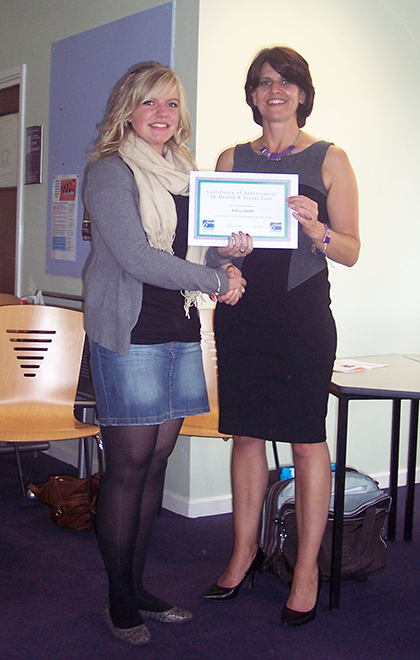
- The BTEC specification uses a combination of assessment styles to give learners confidence they can apply their knowledge to succeed in the workplace – and have the study skills to continue learning on higher education courses and throughout their career.
- The range of vocational assessments – both practical and written – mean learners can showcase their learning and achievements to best effect when they take their next step, whether that’s supporting applications to higher education courses or potential employers.
Why study BTEC Health & Social Care at Solihull Sixth Form College?
- Learners will have the opportunity through vocational experience to interact with the health, social care and early years sectors, providing the learner with the opportunity to experience the work environment through their learning.
- A variety of teaching methods and learning experiences will be used ranging from classroom based activities through to visiting specialist speakers and the keeping of a work placement log book linked to Unit 6 throughout the course.
Course Outline
8 mandatory units, including 4 units of external assessment and 4 units of internal assessment, comprising 72% of the total BTEC course:
Unit 1: Human Lifespan Development (external assessment)
Unit 2: Working in Health and Social Care (external assessment)
Unit 3: Anatomy & Physiology for Health and Social Care (external assessment)
Unit 4: Enquiries into Current Research in Health and Social Care (external assessment)
Unit 5: Meeting Individual Care and Support Needs (internal assessment)
Unit 6: Work Experience in Health and Social Care (internal assessment)
Unit 7: Principles of Safe Practice in Health and Social Care (internal assessment)
Unit 8: Promoting Public Health (internal assessment)
Learners must complete the following five optional units, all internally assessed, comprising 28% of the total BTEC course (the Health & Social Care team choose these in advance of the course commencing):
Unit 10: Sociological Perspectives
Unit 11: Psychological Perspectives
Unit 14: Physiological Disorders
Unit 18: Assessing Children’s Development Support Needs
Unit 19: Nutritional Health
Assessment
42% external assessment will consist of three written exams and one set case study completed under supervised conditions. All external assessment is set and marked by the exam board.
58% internally assessment coursework will be written and marked in college by the teaching staff.
Examining Board – Pearson
Special Entry Requirements
Standard BTEC entry requirements apply. A clear DBS ‘Disclosure and Barring Service’, due to the vocational aspect of the qualification and the requirement to undertake vocational experience, is also needed. The cost of the DBS is approximately £68.00 and you are responsible for this payment (details of how to pay will be provided).
Prohibited Options
None.
What do our learners go on to do?
This course is equivalent to 3 A levels. On completion of this qualification, you can progress into employment in the Health & Social Care industry or alternatively you will be able to apply directly to University to enrol on courses to become nurses, paramedics, midwives, occupational therapists and social workers for example. Please note that for some of these careers, having achieved Science GCSE at grade 4 or above may be necessary.
Work Placement
On this course you will be expected to undertake a work experience placement in both the first and the second year, the purpose of which is to gather information and insights about the workplace, which can be included in your College assignments. Work placements also help develop your employability skills. By the end of the course, you will have gained relevant skills and have a CV with cover letter along with a LinkedIn account. Joining LinkedIn will offer you career opportunities now and will assist your long-term career aspirations, as your profile will be accessible by thousands of prospective employers. Throughout your time at college, you will use the LinkedIn account to record all of your activities including work experience, any part-time paid employment and gain access to relevant professional links.
This information is correct for September 2024 entry.