

This course is a BTEC Extended Diploma, equivalent to studying 3 A levels.
Why study Applied Science?
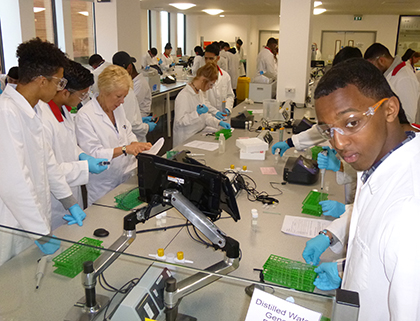
- The BTEC Level 3 National Extended Diploma in Applied Science uses a combination of assessment styles to give learners the confidence to apply their knowledge to succeed in the workplace and develop the study skills to continue learning throughout their career.
- There is a range of assessments – both practical and written – which allow learners to showcase their knowledge and skills to best effect when they take their next step, such as applications to higher education courses or to potential employers.
- 57% of the assessment is done by internally assessed coursework so it is a good option for learners who do not want to follow a 100% exam-based course like A levels. The remaining 43% is assessed by exams.
- The course covers a range of Biology, Chemistry, Physics and Science topics giving an excellent foundation for many university courses, jobs or apprenticeships.
Why study Applied Science at Solihull Sixth Form College?
- The course is delivered in a variety of ways to help you to develop a range of skills. There are laboratory-based practical assignments, supported by self-study, presentations, group work and discussion.
- Throughout your course you will be taught by specialist Biology, Chemistry and Physics teachers and supported by a team of technicians.
- As a part of the course you will complete two work experience weeks giving you an insight into the world of work and allowing you to find out about potential future careers.
- Lessons are taught in specialist laboratories with access to equipment which enables you to develop your practical skills.
- There is also an opportunity for learners to join our new STEM Programme enrichment and work towards a CREST award.
Course Outline
The BTEC Level 3 National Extended Diploma in Applied Science qualification consists of mandatory and optional units, which are assessed by different methods. You will study a total of 13 units which include:
Year 12:
Unit 1: Principles and Applications of Science (Exam)
Unit 2: Practical Scientific Procedures and Techniques (Internal)
Unit 3: Science Investigation Skills (Exam)
Unit 4: Laboratory Techniques and their Application (Internal)
Unit 10: Biological Molecules and Metabolic Pathways (Internal)
Unit 18: Industrial Chemical Reactions (Internal)
Year 13:
Unit 5: Principles and Applications of Science II (Exam)
Unit 6: Investigative Project (Internal)
Unit 7: Contemporary Issues in Science (Exam)
Unit 9: Human Regulation and Reproduction (Internal)
Unit 17: Microbiology and Microbiological Techniques (Internal)
Unit 21: Medical Physics (Internal)
Unit 23: Forensic Evidence, Collection and Analysis (Internal)
Assessment
Mandatory units – 57% externally assessed, 43% coursework.
Optional units – 100% coursework.
Examining Board – Pearson.
This 13 unit qualification is the equivalent of three A Levels. Grades are awarded from Triple Distinction* to Triple Pass and carry the normal number of UCAS points for university entry.
Special Entry Requirements
Grade 4 or above in GCSE Mathematics and two grade 4s from Biology, Chemistry and Physics or grade 4-4 in Combined Science. In addition, standard BTEC/T level entry requirements.
Prohibited Options
None.
What do our learners go on to do?
Biomedical Science is a very popular choice. For the highest achievers, Pharmacy is an option. In recent years, our students have progressed to Animal Biology, Forensic Sciences, Pharmaceutical Science, Dental Technology, Quantity Surveying, Chiropractic, Nursing and Accounting degrees.
Work Placement
You will be expected to undertake a work experience placement in both the first and the second year, the purpose of which is to gather information and insights about the workplace, which can be included in your assignments. Work placements also help develop your employability skills. A clear DBS ‘Disclosure and Barring Service’ may be needed depending on the nature of the placement. The cost of the DBS is approximately £68.00 and you are responsible for this payment (details of how to pay will be provided). By the end of the course, you will have gained new skills and have a CV with cover letter along with a LinkedIn account. Joining LinkedIn will offer you career opportunities now and will assist your long-term career aspirations, as your profile will be accessible by thousands of prospective employers. Throughout your time at College, you will use the LinkedIn account to record all of your activities including work experience, any part time paid employment and gain access to relevant professional links.
Cost Implications
Payment for transport for visits. Payment for DBS check for work experience (if this is required for either of your placements).
Complementary Subjects or Enrichments
There will be opportunities throughout the course to go on trips and visits relevant to your studies, as well as guest speakers from universities and local employers.
This information is correct for September 2024 entry.