

Why study Further Maths?
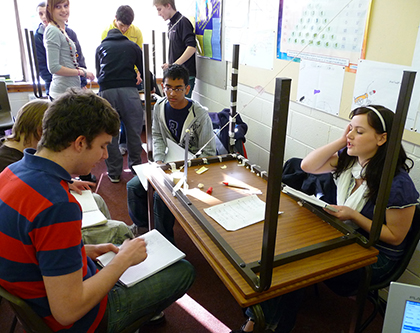
- Studying Further Mathematics is challenging, fun and rewarding for anyone who has a strong interest in Mathematics.
- It is advisable to study Further Mathematics if you’re thinking of studying Mathematics or a mathematics related degree such as Physics, Computer Science or Engineering at university. It is encouraged by many universities, and is a requirement for some courses. It is particularly helpful preparation for a Mathematics degree.
- Studying the new topics introduced in the A level, such as complex numbers and matrices, really helps the transition to studying Mathematics at university.
- Higher level mathematics qualifications often lead to better paid, more interesting careers.
- Studying Further Mathematics is likely to improve your grade in A level Mathematics.
Why study Further Maths at Solihull Sixth Form College?
- A level Further Mathematics is an additional, full A level that you study alongside A level Mathematics and it is usually taken as part of a four A level programme, although it can also be taken as part of a 3 A level programme (See Special Entry Requirements overleaf).
- The Mathematics Department is staffed by enthusiastic, well qualified and experienced teachers of Mathematics and Further Mathematics who use a variety of teaching methods and technology to support your learning.
- Attending a large sixth form college allows learners to study with other able, keen mathematicians who support and inspire each other.
- There is support available for progression to demanding Universities requiring entrance examinations.
- There are many enrichment events available to keen mathematicians including UKMT mathematics challenges (both individual and team), the Mathematical Olympiad for Girls and opportunities that arise at local universities.
Course Outline
Year 12
You will cover essential pure mathematical methods such as the principles of proof, complex numbers and matrices.
You will also extend the mechanics and statistics work covered in your Maths A level to include momentum, circular motion, work and energy, the Poisson distribution and chi-squared contingency tables.
Year 13
The work in pure mathematics is extended to include topics such as rational and hyperbolic functions, further calculus and polar coordinates.
There will also be more material in the applied mathematical topics to study further, including simple harmonic motion, centres of mass and moments, the exponential, rectangular and t-distributions and calculation of confidence intervals.
Assessment
No Coursework
Examination (100%)
Examining Board – AQA.
Special Entry Requirements
Minimum grade 7 or A or above in GCSE Mathematics. Further Maths is usually taken as part of a 4 A level programme, which also includes A level Mathematics. Learners may take Further Maths as part of a 3 A level programme and will be interviewed by a senior member of staff or a member of the Maths Leadership Team, as specialist advice is required for some higher education options. In addition, entry requirements for studying three or four A levels (as applicable) apply .
Prohibited Options
Statistics and Level 3 Mathematical Studies (Core Maths).
What do our students go on to do?
There is a shortage of people with strong mathematical skills. Learners with Further Mathematics commonly take up top professional careers in a wide variety of areas. These include Insurance and Actuarial Work, Finance, Management, Operational Research, Civil, Mechanical and Electrical Engineering, Architecture, Government, Medical or Pharmaceutical Statisticians and Business Analysts. This is a valuable option for learners considering Mathematics, Physics, Engineering or Economics degrees.
Cost Implications
You will be expected to purchase a Graphical Calculator (specific model will be given at the start of the course) and some work will be done using computers.
Complementary Subjects or Enrichment Courses
Physics, Computing, Economics, Chemistry, Biology, Geography, Psychology or Business Studies. There is always support available for progression to demanding Universities requiring entrance examinations.
This information is correct for September 2024 entry.